 Skip to content
How Do You Move a Refrigerator by Yourself?
To move a refrigerator yourself, empty and disconnect it, measure the route, protect the floors, and strap it to a properly rated appliance dolly. Work with a helper, roll it slowly up a secured truck ramp, then stand it upright and fasten it to suitable cargo anchors. Follow the exact model’s instructions for tilting and restarting.
A DIY move still calls for help. A full-size fridge is tall, awkward to balance, and difficult to control at a doorway or ramp. Both Whirlpool’s moving guide and U-Haul’s refrigerator guide describe moving with another person.
Start with your appliance’s listed product weight. Our refrigerator weight guide compares common types and actual manufacturer examples so you can plan the equipment and help you need.
What Do You Need to Move a Refrigerator?
Prepare the loading equipment before disconnecting the appliance. A truck large enough to fit the fridge upright, a suitable loading ramp or liftgate, and a clear route make the job easier to control.
| Equipment | Purpose | What to check |
|---|---|---|
| Appliance dolly with strap | Supports and restrains a tall appliance. | Capacity, wheels, toe plate, strap, and the dolly’s operating instructions. |
| Capable helper | Spots turns, thresholds, and the ramp. | Agree on directions and a clear stop command. |
| Blankets and appliance-safe wrap | Protects surfaces and holds doors closed. | Keep material clear of wheels and moving parts. |
| Floor protection | Reduces marks and concentrated wheel damage. | Cover the entire route; keep protectors flat. |
| Rated cargo straps | Restrains the fridge inside the vehicle. | Working load limits, condition, and suitable vehicle anchors. |
| Rated ramp or liftgate | Bridges the truck deck without a high manual lift. | Compatibility, seating, capacity, traction, and the operator’s instructions. |
| Tape measure, towels, cooler | Plans fit, catches drainage, and protects food. | Measure turns and openings; use a thermometer for cold food. |
OSHA’s heavy-lifting guidance recommends mechanical handling aids and ramps or liftgates for loading heavy equipment. Choose a method that lets your team control the load throughout the move.
How Do You Prepare a Refrigerator for Moving?
Measure the appliance and route
Check height, width, depth, handles, doorways, corners, landings, elevators, and the truck opening. Allow room for the dolly and the people controlling it. If doors or handles need removal, follow the exact manual; dispenser wiring or water tubing may pass through a door.
Empty, clean, and defrost
Remove food and loose glass shelves, bins, and drawers. Pack removable parts separately or secure them as directed. Allow frost and ice to thaw, catch drainage with towels, and dry the interior before loading.
Disconnect power and water
Turn off the ice maker and water supply where applicable. Unplug the refrigerator and disconnect its water line according to the manual. Secure the cord and tubing. If the shutoff valve cannot be identified or closed, arrange appliance or plumbing help.
Protect the floor and finish
Use suitable floor protection and blankets. Secure doors with appliance-safe materials; avoid adhesive on delicate finishes. Raise leveling legs or adjust rollers only as directed. Protectors must stay flat under the dolly.
Preparation varies by appliance. See Maytag’s moving preparation guidance and your model’s manual. Maytag advises pulling its refrigerators straight out rather than walking them side to side, which can damage flooring.
Plan for the food, too. Keep perishables in a cooler with ice or gel packs and a thermometer. FoodSafety.gov recommends refrigeration at 40°F or below and limits unrefrigerated perishables to two hours, or one hour when exposed to temperatures above 90°F. An unplugged fridge in a truck is not reliable cold storage.
How Do You Load a Refrigerator Into a Moving Truck?
Use an appliance dolly and a helper to move the prepared fridge to the truck, up the secured ramp, and into its upright transport position. Plan the destination and anchor points before it reaches the cargo deck.
Park and inspect the ramp
Set the parking brake and use stable, level ground where practical. Fully seat or latch the ramp according to the truck instructions. Check capacity and traction; clear water, loose wrap, and obstacles from the approach.
Secure the fridge to the dolly
With your helper steadying the cabinet, position the toe plate and strap as the appliance and dolly instructions specify. Protect contact points. Avoid pushing on handles, dispensers, or exposed tubing.
Clear thresholds slowly
Lean only as needed to balance the dolly within the model’s limits. Have the helper watch corners and floor changes. Stop to reset if a wheel catches, a protector shifts, or the refrigerator moves against its strap.
Go up the ramp with a spotter
For its ramps, U-Haul tells dolly operators to walk backward up the ramp. Keep your footing visible and move in controlled steps. The helper guides alignment without standing beneath an unstable load. Pause if control becomes difficult.
Stand it upright in position
Keep the fridge on the cargo floor, with the heavy load toward the front of the truck near the cab. Choose a position with suitable anchors, while respecting the vehicle’s payload and axle limits and the rest of the load.
Tie it down and check movement
Attach rated restraints to appropriate anchors or rails. Pad contact points and prevent rolling, sliding, and tipping without crushing panels or fittings. Keep the appliance controlled while removing the dolly. Recheck after loading nearby items.
Follow the equipment-specific truck loading instructions and ramp instructions. If the ramp is slippery, unsecured, too narrow, too steep to control the load, or inadequately rated, change the setup before proceeding.
Manufacturer advice: GE says to “always truck from the side” in its refrigerator moving instructions. That is guidance for GE appliances. Check your own model before deciding which face goes against the dolly.
How Do You Secure a Refrigerator in a Moving Truck?
Stand it upright, use suitable cargo anchors, and restrain it so it cannot roll, slide, or tip. Blankets protect surfaces and wrap holds the doors shut; neither replaces a tie-down. Keep straps clear of vulnerable handles, hinges, dispensers, and water fittings. Check the appliance again once the other cargo is loaded.
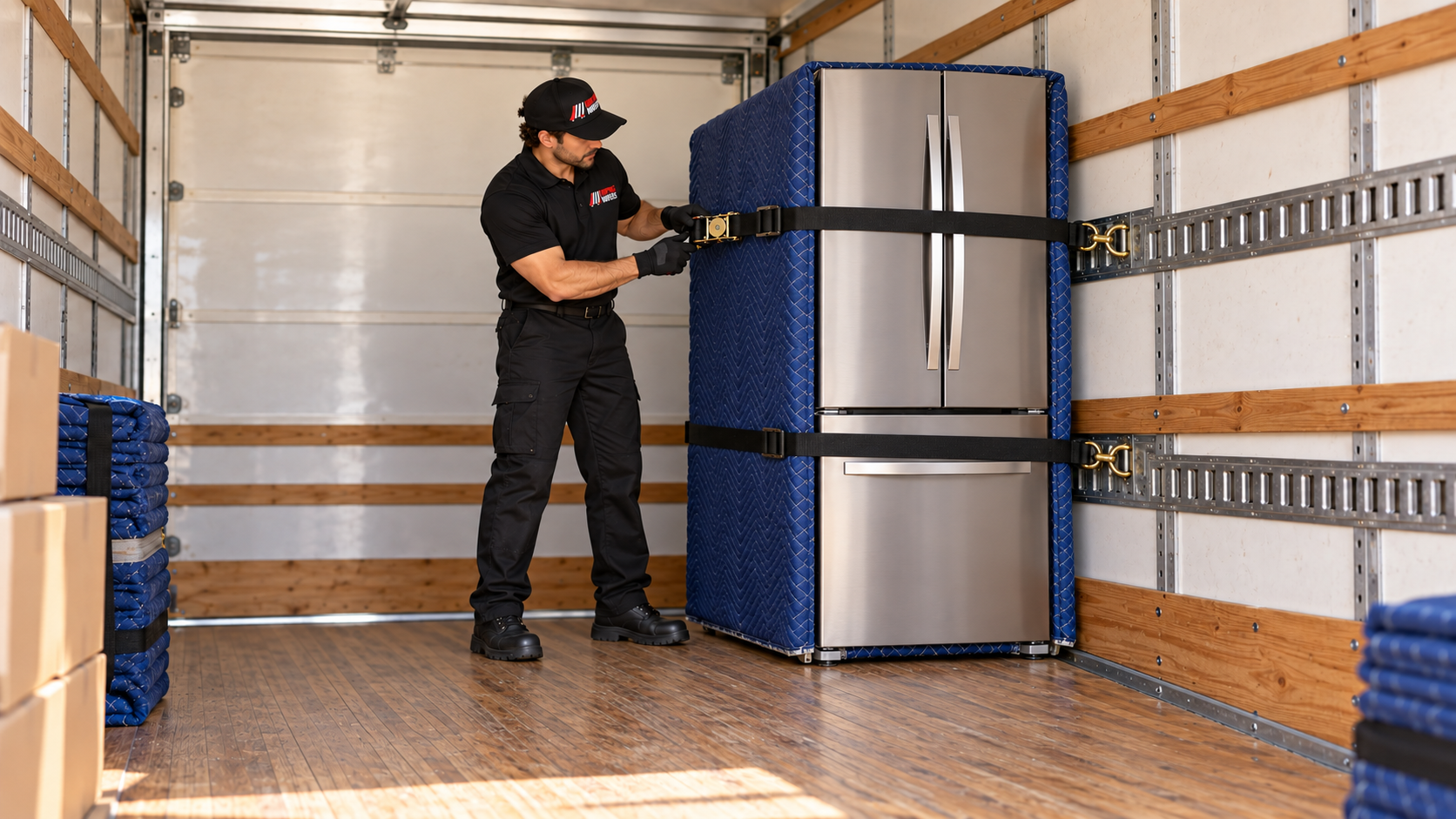
U-Haul’s refrigerator guide describes securing the appliance with tie-down gear and using moving-truck rails. A closed cargo door or neighboring boxes should not be the only thing keeping it in place.
How Do You Load a Refrigerator Into a Pickup Truck?
First decide how the fridge will cross the tailgate safely. A pickup’s higher bed makes loading harder. Use a compatible, properly rated loading system and enough help to control the appliance. If you lack that setup, arrange qualified loading help or use a low-deck moving truck with a suitable ramp.
When the vehicle and model allow the move, keep the refrigerator upright near the front of the bed toward the cab, attach restraints to appropriate bed anchors, and verify payload and overhead clearance. Protect it from weather without compromising the tie-downs. U-Haul’s pickup cargo guide explains load placement, working load limits, and bed anchor points.
| Situation | Loading plan |
|---|---|
| Moving truck with suitable ramp | Rated appliance dolly, helper, upright placement, and cargo restraints. |
| Pickup with rated loading equipment | Verify equipment compatibility, payload, upright fit, crew control, and bed anchors. |
| Pickup without suitable loading equipment | Change vehicles or arrange professional help rather than improvising a high manual lift. |
| Stairs or tight landings | Assess the entire route and use equipment and trained help appropriate for the appliance. |
Can You Transport a Refrigerator on Its Side?
Keep the refrigerator upright whenever possible. Side transport is allowed only when the instructions for the exact model permit it. GE allows some top-freezer and side-by-side models to travel on a specified side, while requiring its French-door, bottom-freezer, and built-in models to remain upright in a vehicle. GE’s compact-model guidance also calls for upright handling and explains limited exceptions.
These are manufacturer examples. If a truck will not accommodate the required upright position, choose a vehicle that fits. Do not assume that a side suitable for one model is suitable for another.
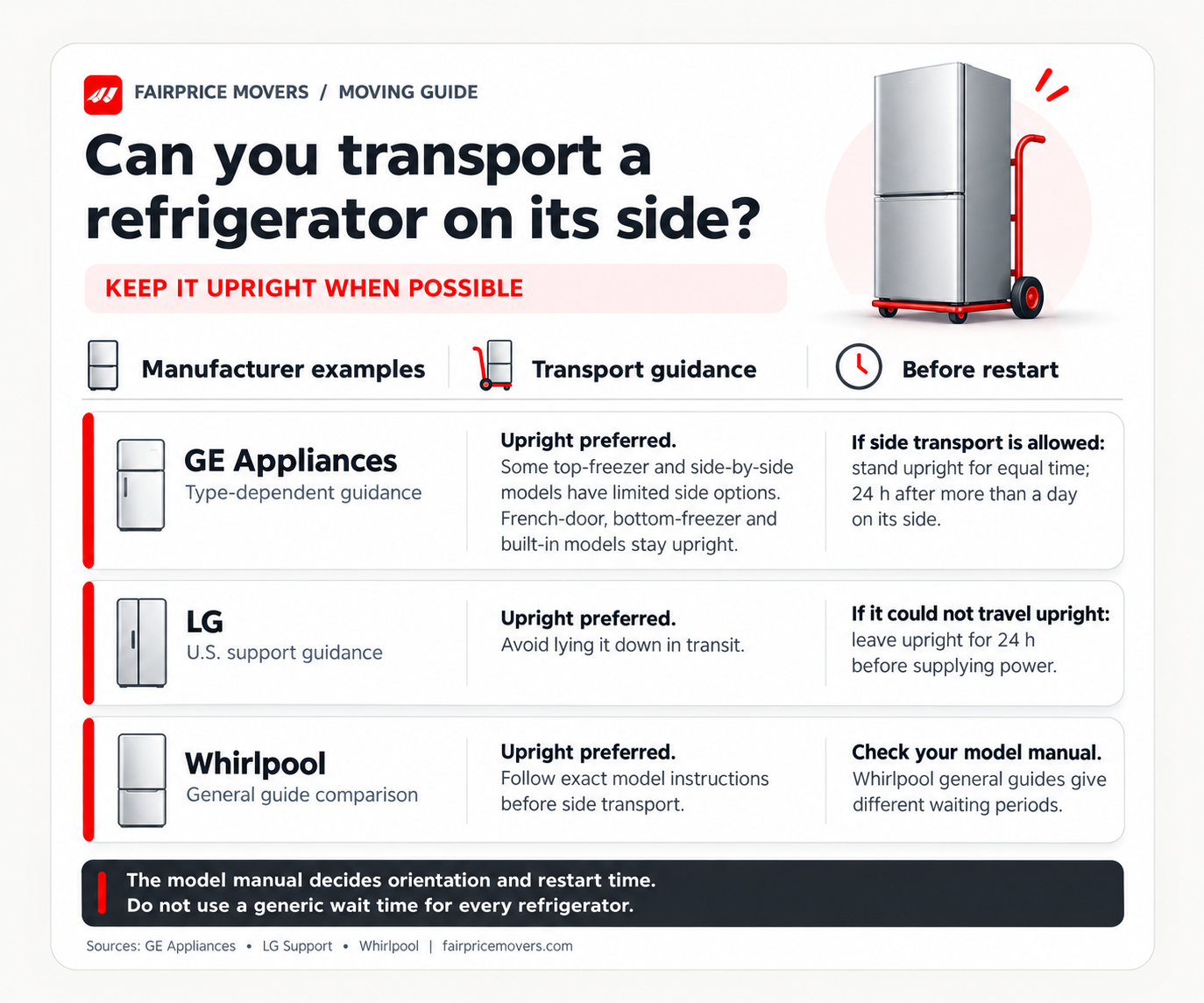 View Full-Size Chart
 | Manufacturer | Transport guidance | Restart guidance |
|---|---|---|
| GE Appliances | Upright preferred; limited side options for some top-freezer and side-by-side models. French-door, bottom-freezer, and built-in models remain upright. | For eligible models moved on a side, stand upright for the same amount of time; 24 hours if it was on its side for more than a day. |
| LG | Upright transport preferred. | The cited U.S. transport guide recommends 24 hours upright before power if it could not be transported upright. |
| Whirlpool | Upright preferred; consult the exact model instructions before side transport. | General moving and installation pages give different waiting periods. Check the model manual or manufacturer support. |
How Long Should a Refrigerator Sit After Moving?
Follow the exact model’s restart instructions and account for whether it remained upright. There is no single wait time for every refrigerator. Whirlpool’s moving guide says at least eight hours after side transport, while its installation guide says at least 24 hours in that situation. That difference is a reason to check the specific manual rather than choose a generic number.
Plan unloading before releasing the restraints. Use the appropriate dolly, helper, and vehicle instructions to bring the appliance down under control. At its destination, level it, reconnect water as directed, and check for leaks.
Restart time and cooling time are different. After the permitted restart, keep perishables in their cooler until the fridge reaches a safe temperature. Check with a thermometer: FoodSafety.gov recommends 40°F or below for the refrigerator and 0°F or below for the freezer.
How Do You Prepare a Refrigerator for Storage?
Empty, clean, defrost, and dry it thoroughly. Follow the manufacturer’s storage guidance, including ventilation and door position, and confirm the facility’s requirements. Maytag recommends keeping a stored fridge dry and its doors secured ajar for airflow. Keep the unit secure and inaccessible to children; do not leave a stored appliance where someone could become trapped inside.
If delivery timing requires a storage stop, plan access, truck placement, and the destination together. Explore FairPrice Movers’ storage moving services for help coordinating the transfer.
Questions About Moving a Refrigerator Yourself
Can one person move a full-size refrigerator?
Plan for a helper. Tipping the fridge onto a dolly is only one part of the task; turns, thresholds, and the ramp also require control and visibility. Larger appliances or difficult access may need additional trained help.
How do you move a fridge without a dolly?
For truck loading, arrange a rated appliance dolly or another appropriate handling system first. Briefly sliding a refrigerator out of its kitchen cutout is different from transporting it through a house and into a vehicle. Whirlpool recommends a dolly for moving beyond the cutout.
How do you move a fridge without scratching the floor?
Protect the route, keep floor coverings flat, and follow the model’s roller and leveling-leg instructions. Avoid dragging feet sideways. Watch thresholds, where a dolly wheel or moving protector can concentrate weight on the flooring.
How do you move a refrigerator up or down stairs?
Measure stair width, landing depth, turns, and overhead clearance before starting. Use equipment rated and designed for the route, following its instructions. Full-size refrigerators on stairs may require more than two people or a trained crew; do not attempt a solo stair move or rely on someone catching the load.
What if the refrigerator will not fit through the doorway?
Stop and recheck the opening, handles, hinges, and dolly clearance. If the appliance manual allows door removal, follow its wiring and water-connection instructions. An alternate route or professional appliance help may be needed.
Can you load a refrigerator into a pickup without a ramp?
Use a suitable rated loading system or arrange qualified help. Tying the fridge down in the bed does not solve the difficult high lift required to get it there. A moving truck with a compatible ramp may offer a more manageable approach.
How much does it cost to move a refrigerator?
The quote depends on size, weight, stairs, truck access, distance, equipment, and whether it is part of a household move or a separate pickup. Share the model, dimensions, connections, and route details when requesting a moving estimate. Plumbing or appliance servicing requirements should be discussed separately.
Know the Weight Before Choosing Your Equipment
Appliances need different preparation. Check the refrigerator’s product weight, and use the washer’s specific drainage and transport-hardware instructions when moving a laundry machine.
Need Help Moving a Refrigerator?
Tell FairPrice Movers the appliance model, stairs, truck access, and delivery requirements. We’ll help plan the crew and equipment for your household move.